How Hand Tracking Shapes Detective VR on PS VR2
Detective VR launches on PlayStation VR2 and Steam on September 9, bringing its time-bending investigation to a new audience. We spoke with Alexandre Garland, CEO & Game Designer at Studio Chipo y Juan who developed the game, and Jaakko Asikainen, CTO and head of the PS VR2 port at VRKiwi, about how the game came together and the challenge of bringing its hand-tracking experience to PS VR2.
Looking for Clues, Not Checking Boxes
Many detective games tell you what you’re looking for. Detective VR takes a different approach.
A clue might be something a character says that doesn’t match an earlier testimony. It could be a glance between two characters, the position of an object, or something happening in the background while someone else is talking.
The game is designed to reward attention rather than simply finding highlighted objects.
“We want the player to feel, ‘I understood that,’ not, ‘the interface gave me the answer.’”
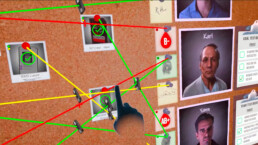
Players can compare testimonies, revisit evidence, rewind scenes and build their own connections on the investigation board. And sometimes, the best clue might be something you almost missed.
Rewinding Time to Find the Truth
Time control became one of the game’s defining mechanics.
The original idea was simple: imagine having the ability to stop a conversation, look around the room and replay the exact moment when something felt wrong. In Detective VR, that becomes a tool for investigation. Players can freeze a scene, move around characters, examine their reactions from another angle and rewind to compare what was said with what actually happened.
Time isn’t simply a way to replay a scene. It’s another way of looking at the evidence.
Why Hand Tracking Matters
One of the most distinctive parts of the PS VR2 version is its controller-free hand tracking.
For the developers, this isn’t a feature added just because the technology is available. Hand tracking was central to the original identity of Detective VR when originally developed for Meta Quest.
“When you remove the controllers, you are no longer pressing a button to imitate an action. You simply reach toward the evidence, point at a detail, move an item or organise your board with your own hands.”
That changes how the investigation feels. You can pick up a piece of evidence and turn it around naturally. Bring it closer to examine it. Reach across the investigation board to connect clues. Pick up the magnifying glass and bring it towards something you’re examining.
The actions themselves aren’t necessarily different from using a controller. But the feeling is.
“Picking up clues feels less like selecting an inventory item and more like handling something that belongs to the case.”
And that’s exactly what the team wanted.
Making Hand Tracking Feel Natural
Getting there wasn’t completely straightforward.
The PS VR2 port was handled by the VRKiwi team, with Jaakko Asikainen leading and supervising the work. Hand tracking presented its own technical challenges: fingers can hide each other, fast movements can be difficult to read, and hands can leave the headset’s cameras’ field of view.
A lot of the work went into making interactions feel predictable even when tracking wasn’t perfect. Something as simple as picking up and releasing an object needed to feel responsive without accidentally triggering actions.
The team’s work paid off when they reached one particular moment: the investigation board.
“Once we could take a clue with our fingers, place it where we wanted, create a connection and then step back to look at the whole case, the interface stopped feeling like an interface. It felt like detective work.”
That’s perhaps the best description of what the team is trying to achieve with Detective VR.
The People Are Part of the Evidence
The investigation isn’t only about physical clues. The suspects themselves can be evidence.
The characters were brought to life using motion capture, allowing the actors to perform complete scenes with natural timing, interruptions, hesitation and body language. That’s important because you’re free to look wherever you want.
A character who isn’t speaking might avoid eye contact. Someone might exchange a glance with another character. A small reaction might reveal something that the dialogue doesn’t. The performances aren’t just there to make the story more believable. Reading people is part of solving the case.
A New Platform for a Small Team
For the team behind Detective VR, bringing the game to PlayStation VR2 is an important milestone. The PS VR2 version wasn’t simply a matter of moving the existing game to another headset. Studio Chipo y Juan and VRKiwi worked together on rendering, performance, input, comfort, interface behaviour and extensive testing.
And they wanted to preserve what made Detective VR distinctive along the way.
“Supporting controller-free hand tracking was a major part of that effort because it preserves what makes Detective VR distinctive.”
For the developers, there’s also a particular moment they’re excited for PS VR2 players to experience: the first scene with Agatha, when players unlock Time Control.
Without giving too much away, there’s also a “dance and music sequence” near the end of the game that they’re particularly excited for players to discover.
One Last Piece of Advice
So, what’s the developers’ advice before you step into the investigation?
Don’t rush to accuse anyone. Listen carefully. Compare the evidence. Revisit the timeline. Rewind whenever a sentence, gesture or object doesn’t quite fit.
And most importantly:
“Trust the evidence more than confidence.”
The person who sounds certain isn’t always telling the truth. And sometimes, the smallest reaction can change the meaning of an entire testimony.
Detective VR launches on PlayStation VR2 and Steam on September 9.